What Is Kaedim and How Does This AI Tool Help with AI-powered 3D?
When you hear about AI revolutionizing creative industries, you might wonder, “what is Kaedim?” or perhaps, “what is this AI tool?” This platform is at the forefront of transforming how 3D assets are created, making advanced AI-powered 3D modeling accessible for professionals across various sectors. It’s designed to address the growing demand for high-quality 3D content without the traditional bottlenecks.Understanding Kaedim is crucial for anyone looking to scale their 3D production, reduce costs, and accelerate project timelines. Whether you’re in game development, product design, or e-commerce, the ability to rapidly generate production-ready 3D assets from simple inputs can be a game-changer. This article will explore how this AI solution works and the significant problems it helps solve for creative teams. After reading What Is Kaedim, continue with our detailed Kaedim Review for the full evaluation before choosing.
The Challenge of Slow and Costly 3D Asset Production
In today’s fast-paced digital landscape, the demand for 3D assets is exploding across industries like gaming, product visualization, and marketing. However, the traditional process of creating these assets is notoriously slow, expensive, and resource-intensive. Manual 3D modeling requires highly skilled artists, significant time investment, and often extensive iteration cycles, leading to frustrating bottlenecks.This conventional approach means projects frequently face budget overruns and missed deadlines. Teams are under constant pressure to deliver more 3D content faster, but the capacity to produce it simply cannot keep up. This creates a significant hurdle for studios and businesses aiming to innovate and maintain a competitive edge in their respective markets.
Beyond Speed: Addressing Skill Gaps, Scalability, and IP Security
The challenges in 3D production extend far beyond just speed and cost. Many organizations struggle with a persistent shortage of skilled 3D artists, making it difficult to hire and retain the talent needed to meet escalating demands. This scarcity often leads to inconsistent art styles across large projects and an inability to scale production effectively without compromising quality or increasing overheads exponentially.
Furthermore, scaling 3D asset creation through traditional means, such as extensive outsourcing, introduces its own set of complexities. Managing multiple external vendors can be cumbersome, and ensuring consistent quality and adherence to specific brand guidelines becomes a logistical nightmare. This fragmented approach can also slow down iteration and review processes considerably.A critical concern for businesses is the security of their intellectual property (IP).
When sensitive designs, prototypes, or game assets are shared with various external parties for 3D modeling, the risk of IP compromise increases significantly. Protecting creative assets is paramount, and traditional workflows often present vulnerabilities that can lead to costly security breaches and loss of competitive advantage.
The Real Impact: Why These 3D Production Challenges Matter
These persistent problems in 3D asset creation have tangible and often severe consequences for businesses. Financially, the high costs of manual modeling and the delays in production directly impact project budgets and return on investment. Every extra hour spent on an asset, or every missed deadline, translates into lost revenue and diminished profitability, making it harder to justify ambitious 3D initiatives.Operationally, slow 3D pipelines lead to significant inefficiencies. Creative teams become bogged down in repetitive tasks, stifling innovation and diverting valuable resources from more strategic work.
This can result in slower time-to-market for new products, games, or marketing campaigns, allowing competitors to gain an advantage and capture market share.Ultimately, these challenges create immense frustration for everyone involved, from lead artists struggling to manage workloads to management worried about project viability. The inability to rapidly iterate on designs, scale production on demand, or ensure IP security can limit creative freedom, hinder strategic growth, and prevent businesses from fully leveraging the power of immersive 3D content.
Kaedim: Your AI-Powered Partner for Rapid 3D Asset Generation
In a world where digital experiences are increasingly defined by stunning 3D visuals, Kaedim emerges as the much-needed hero, directly tackling the formidable challenges we’ve just explored. This innovative platform isn’t just another tool; it’s a strategic solution designed to democratize 3D asset creation, making it faster, more affordable, and incredibly scalable. For anyone asking, “what is this AI tool that can actually solve my 3D production headaches?”, Kaedim is the answer, transforming complex manual processes into streamlined, AI-driven workflows.
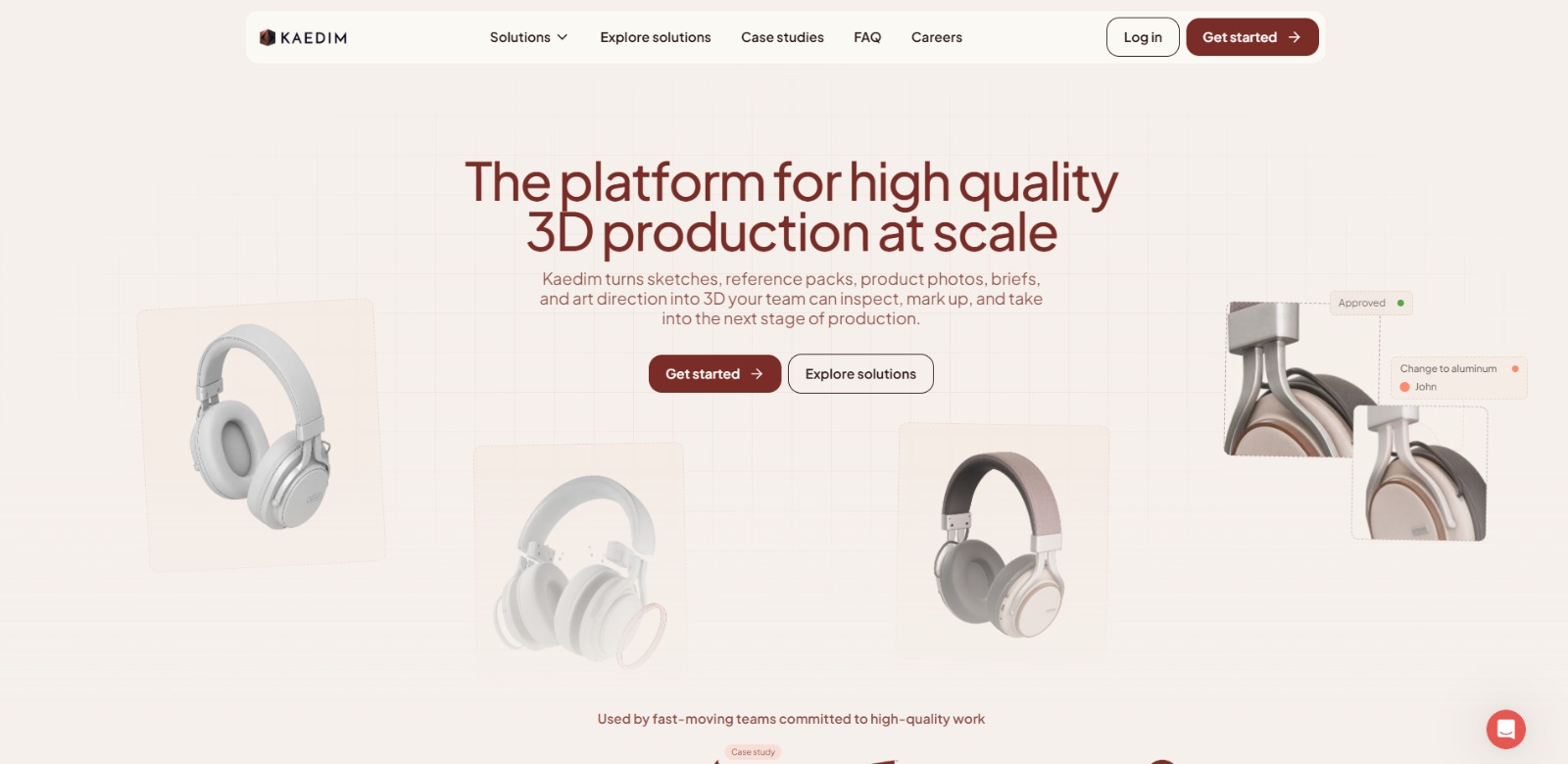
It’s about empowering creative teams to produce high-quality 3D models from simple inputs, whether those are text descriptions or 2D images.Kaedim effectively bridges the gap between ambitious creative visions and the practical constraints of budget, time, and talent. By leveraging advanced artificial intelligence, it significantly reduces the reliance on extensive manual modeling, freeing up skilled artists to focus on higher-level creative tasks and refinements. This means game developers can populate their worlds faster, product designers can iterate on prototypes with unprecedented speed, and e-commerce businesses can visualize their offerings in immersive 3D without breaking the bank. It’s a game-changer for anyone looking to scale their 3D content production without compromising on quality or security.
How Kaedim Transforms Your Ideas into Production-Ready 3D
The magic of Kaedim lies in its ability to simplify what was once a highly complex, multi-stage process into an intuitive, AI-accelerated workflow. Think of it as having a super-efficient 3D modeling assistant at your fingertips, ready to interpret your creative brief and deliver a foundational model in record time. The platform is designed to be accessible for professionals, streamlining the journey from concept to a fully realized 3D asset, ready for integration into various projects. It’s about making the creation process less about technical hurdles and more about pure creative expression.
Input Your Vision
The journey begins with your input. Users can feed Kaedim their creative vision in a straightforward manner. This typically involves providing either a text prompt, describing the desired 3D object in detail, or uploading a 2D image as a reference. Imagine you need a “futuristic space helmet” or have a sketch of a new product design – Kaedim takes these initial inputs and uses its AI to understand the core elements and characteristics you’re aiming for. This foundational step is designed to be as simple as possible, allowing creators to quickly convey their ideas without needing to be 3D modeling experts from the outset.
AI Does the Heavy Lifting
Once your input is received, Kaedim’s powerful AI engine springs into action. This is where the platform truly shines, leveraging sophisticated algorithms to interpret your prompt or image and generate a preliminary 3D model. The AI works to convert your 2D reference or textual description into a three-dimensional mesh, complete with initial topology and form. This automated generation significantly cuts down on the initial modeling time, which traditionally consumes a large portion of a 3D artist’s efforts. It’s like having an incredibly fast sculptor who can rough out the main shape of your object in moments.
Refine and Personalize
After the AI generates the initial model, the power shifts back to the user for refinement. Kaedim provides tools that allow artists and designers to review, adjust, and personalize the AI-generated asset. This might involve tweaking proportions, adjusting details, or adding specific textures and materials to ensure the model perfectly aligns with the project’s aesthetic and technical requirements. This human-in-the-loop approach ensures that while the AI accelerates the initial creation, the final output retains the artistic integrity and specific vision of the creator. It’s where the raw AI output gets its polished, production-ready finish.
Export Your Masterpiece
The final step is to export your completed 3D asset in a format compatible with your preferred software or engine. Kaedim supports various industry-standard formats, making it easy to integrate your newly created models into game engines like Unity or Unreal Engine, 3D design software, or visualization platforms. This seamless export capability ensures that the efficiency gained during the creation process extends all the way to deployment, allowing teams to quickly move from concept to implementation. This comprehensive workflow makes Kaedim an invaluable asset for accelerating any 3D production pipeline. For a deeper dive into its capabilities, you might want to explore its comprehensive features.
The Transformative Benefits of Integrating Kaedim into Your Workflow
The real value of Kaedim isn’t just in its cool AI tech; it’s in the tangible benefits it delivers to creative teams and businesses. By automating the most time-consuming aspects of 3D modeling, the platform dramatically accelerates production cycles. This means projects can move from concept to completion much faster, allowing businesses to bring new products to market sooner, launch games ahead of schedule, or deploy marketing campaigns with rich 3D content more efficiently. The reduction in manual labor also translates directly into significant cost savings, making high-quality 3D content accessible even for projects with tighter budgets.Beyond speed and cost, Kaedim addresses the critical challenges of scalability and consistency.
With AI handling the foundational modeling, teams can scale their 3D asset production on demand without needing to hire a massive roster of skilled artists or manage complex outsourcing arrangements. This ensures a consistent quality and style across large volumes of assets, which is crucial for maintaining brand identity and project cohesion.
Furthermore, by keeping the creation process largely in-house and streamlined, Kaedim inherently enhances IP security, protecting valuable creative assets from external vulnerabilities. To see how it fits into broader creative strategies, consider how AI tools are enhancing creative workflows.
Empowering Your Creative Vision with AI-Driven 3D
Kaedim stands out as a pivotal AI tool in the evolving landscape of digital content creation. It’s more than just software; it’s a strategic ally for anyone grappling with the traditional bottlenecks of 3D asset production. By intelligently automating the initial, often painstaking, stages of modeling, Kaedim liberates creative professionals from repetitive tasks, allowing them to channel their expertise into refinement and innovation.
This platform is particularly valuable for game developers, product designers, and e-commerce businesses who need to generate high volumes of consistent, quality 3D assets without prohibitive costs or lengthy timelines.Understanding what this AI tool offers means recognizing its potential to transform entire workflows. It’s about achieving unprecedented speed, significant cost efficiencies, and robust scalability, all while maintaining artistic control and enhancing IP security. For teams looking to future-proof their 3D production pipelines and push the boundaries of visual content, Kaedim presents a compelling solution. It empowers creators to bring their most ambitious visions to life, faster and more effectively than ever before.
Unlock Your Creative Potential and Accelerate Your 3D Workflow
Imagine a world where your most ambitious 3D visions aren’t held back by endless manual labor, budget constraints, or tight deadlines. Kaedim offers that reality, transforming the daunting task of 3D asset creation into an intuitive, accelerated journey. It’s about reclaiming valuable time, empowering your artists to focus on true innovation, and scaling your content production with confidence.
This AI assistant doesn’t replace creativity; it amplifies it, ensuring your projects move from concept to stunning realization with unprecedented speed and efficiency.Ready to experience the future of 3D asset creation and see how Kaedim can revolutionize your workflow? Don’t let traditional bottlenecks slow down your creative momentum. Explore the possibilities and discover how this powerful AI tool can help you bring your digital worlds to life faster and more affordably.
Kaedim FAQs
What is Kaedim used for?
What is Kaedim used for?
Who is Kaedim best for?
Who is Kaedim best for?
How does Kaedim generally work?
How does Kaedim generally work?
What should users consider before choosing Kaedim?
What should users consider before choosing Kaedim?
CharlieAITools was created with love to help you discover the best AI tools and transform your life, your ideas, and your projects. We aim to share valuable resources with fellow entrepreneurs. Thanks a ton for your support!