
What Is Sloyd and How Does It Help with AI 3D modeling?
In today’s fast-paced digital world, creating compelling 3D content is more crucial than ever, yet it often comes with significant hurdles. Many creators, from indie game developers to product designers, find themselves asking: what is Sloyd, and can it truly simplify the complex process of 3D asset generation? This article dives deep into understanding this innovative platform, explaining how it leverages artificial intelligence to transform your creative workflow.
Sloyd isn’t just another software; it’s an AI-powered solution designed to democratize 3D creation. It addresses the core challenges faced by anyone needing to generate high-quality 3D models quickly and efficiently, without requiring years of specialized training. By the end of this guide, you’ll have a clear grasp of what Sloyd offers, who it’s for, and how it’s making AI 3D modeling accessible to a broader audience. Now that you know What Is Sloyd, explore our Sloyd Review for a practical breakdown of its strengths and limitations.
The Steep Climb of Traditional 3D Modeling
For years, bringing a 3D vision to life has been synonymous with a steep learning curve, significant time investment, and often, considerable cost. Traditional 3D modeling software, while powerful, demands specialized skills and countless hours to master. Whether you’re sculpting intricate characters or designing detailed environments, the manual process is inherently slow and requires a deep understanding of complex tools and techniques. This reality often creates a significant barrier for creators and businesses alike.
The journey from concept to a finished 3D model typically involves meticulous manual work, from mesh creation and texturing to rigging and animation. This labor-intensive process not only consumes valuable time but also necessitates a substantial budget, especially when hiring experienced 3D artists. For many, particularly indie developers or small design studios, these high costs and time commitments can quickly become prohibitive, forcing them to compromise on their creative ambitions or even abandon projects entirely.
Struggling with Speed, Consistency, and Integration?
Beyond the initial hurdle of manual creation, creators face a cascade of additional challenges that can derail projects. Imagine Alex, an indie game developer, needing to rapidly prototype dozens of unique assets for a new game. Traditional methods make quick iteration almost impossible, stifling the creative process and delaying crucial testing phases. The sheer volume of assets required for modern games, AR/VR experiences, or even e-commerce product visualizations often overwhelms manual workflows.
Maintaining a consistent art style across a large collection of 3D assets is another persistent headache. When multiple artists are involved, or assets are sourced from various places, ensuring a cohesive visual identity becomes a monumental task. Furthermore, getting these assets “game-ready” or “print-ready” involves specific optimizations—like clean topology, proper UV mapping, and efficient rigging—which add another layer of complexity and specialized knowledge. Integrating these perfected models seamlessly into game engines or other 3D software can also be surprisingly cumbersome.
The Real Cost of 3D Modeling Bottlenecks
These pervasive problems in 3D asset creation aren’t just minor inconveniences; they represent significant bottlenecks that carry real costs and consequences. Lost time directly translates to delayed project launches, causing missed market opportunities and potential revenue. For indie developers like Alex, every day spent wrestling with complex software or waiting for assets is a day that eats into a tight budget and pushes back their game’s release date, potentially impacting its success.
The high financial outlay for specialized software and skilled artists can quickly deplete resources, especially for smaller teams or individual creators. More critically, these technical and financial barriers often lead to creative blocks, where innovative ideas are stifled because the means to bring them to life in 3D are too daunting. The frustration of slow iteration can lead to lower quality work, as creators might settle for less-than-ideal designs simply to meet deadlines, or worse, abandon ambitious projects altogether. Ultimately, these challenges limit creative freedom, restrict project scope, and hinder the ability to respond quickly to market demands.
Sloyd: Your AI Co-Pilot for Effortless 3D Creation
The good news is, the era of wrestling with overly complex 3D software is rapidly evolving. Sloyd emerges as a powerful answer to the challenges creators face, acting as an intelligent co-pilot that streamlines the entire 3D asset generation process. It directly addresses the “what is this AI tool?” question by providing a practical, AI-driven solution for quickly generating high-quality 3D models. This platform is specifically designed to cut through the traditional complexities, offering a more intuitive and efficient pathway from concept to finished asset.
By leveraging artificial intelligence, Sloyd empowers users to bypass the steep learning curves and time-consuming manual tasks that often plague traditional 3D modeling. It’s built for anyone who needs to produce compelling 3D content—from indie game developers needing rapid prototypes to product designers visualizing concepts—without compromising on quality or consistency. This innovative approach ultimately democratizes 3D creation, making it accessible to a much broader audience and transforming creative workflows.
How Sloyd Transforms Your 3D Workflow
Sloyd isn’t about replacing human creativity; it’s about augmenting it by simplifying the technical heavy lifting. The platform offers a user-friendly workflow that allows creators to focus on their vision rather than getting bogged down in intricate manual processes. Instead of starting from scratch with polygons and vertices, users interact with an intelligent system that understands their intent. This general process makes 3D modeling more approachable and significantly faster for a wide range of projects.
Step 1: Define Your Vision with Simple Inputs
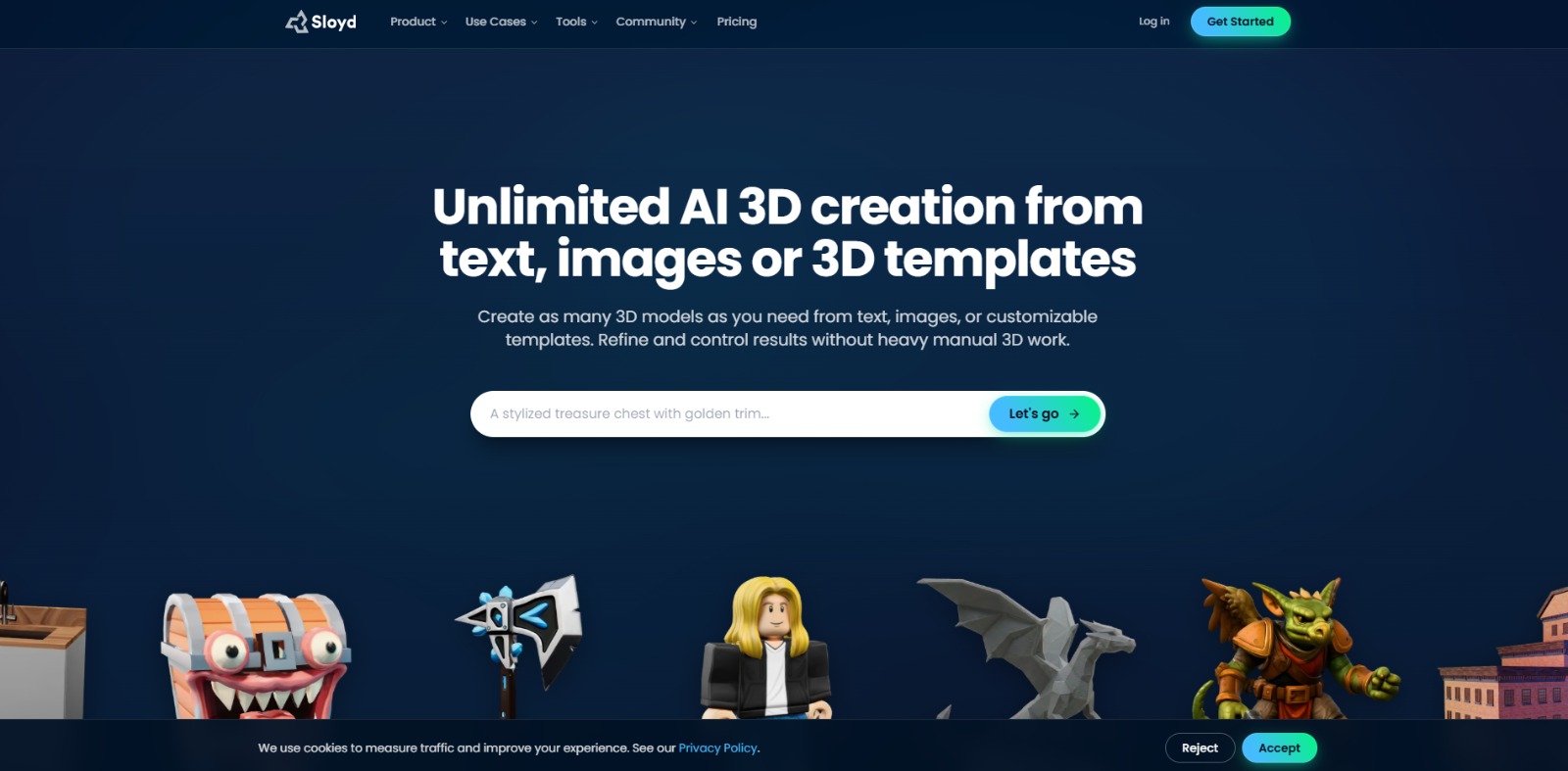
The journey begins by telling Sloyd what you want to create. Instead of sculpting every detail, you provide high-level descriptions or select from a library of base models and templates. Think of it like sketching an idea rather than drawing every line perfectly. For instance, you might specify “a medieval sword,” “a stylized tree,” or “a modern chair.” This initial input guides the AI, setting the foundation for your desired 3D asset. It’s about communicating your concept in an intuitive way.
Step 2: AI Generates and Customizes
Once your initial vision is set, Sloyd’s AI springs into action, generating a preliminary 3D model based on your input. This isn’t a static process; the platform often provides a range of customization options. You can typically use sliders, toggles, or predefined styles to refine the model’s appearance, shape, and details. Want a thicker sword blade or a different leaf density for your tree? These adjustments are often made with simple controls, allowing for quick experimentation and iteration.
Step 3: Iterate and Refine with Ease
One of Sloyd’s core strengths lies in its ability to facilitate rapid iteration. You can quickly generate variations, experiment with different aesthetics, or make significant changes to your model without starting over. This iterative process is crucial for creative exploration, allowing you to fine-tune designs, test different looks, and ensure the asset perfectly fits your project’s needs. It transforms the often-slow refinement stage into a dynamic and responsive experience, fostering creativity.
Step 4: Prepare for Integration and Export
After you’re happy with your 3D model, Sloyd helps prepare it for its final destination. The platform aims to generate assets that are optimized for various uses, whether for game engines, AR/VR applications, or rendering. This often includes features like clean topology, proper UV mapping, and efficient mesh structures, which are traditionally complex manual tasks. Finally, you can typically export your finished model in common 3D file formats, ready to be integrated seamlessly into your chosen software or project.
Unlocking New Possibilities: The Core Benefits of Using Sloyd
The shift to AI-powered 3D modeling with Sloyd brings a cascade of tangible benefits that address the pain points highlighted earlier. Foremost among these is the dramatic acceleration of the creation process. What once took hours or days of meticulous manual work can now be achieved in minutes, freeing up valuable time for creators. This efficiency translates directly into faster prototyping, quicker iteration cycles, and the ability to meet tight deadlines without compromising quality.
Beyond speed, Sloyd significantly lowers the barrier to entry for 3D content creation, empowering more individuals and teams to bring their ideas to life. It ensures greater consistency in art style across multiple assets, a common challenge in larger projects. Ultimately, this AI solution helps reduce financial outlays by minimizing the need for extensive specialized training or costly manual labor, allowing creators to expand their project scope and respond dynamically to market demands.
Sloyd: Empowering Your 3D Vision, Simplified
So, what is this AI tool, Sloyd, truly about? At its heart, Sloyd represents a significant leap forward in making 3D content creation accessible, efficient, and enjoyable. It’s not just another piece of software; it’s an intelligent partner designed to remove the technical barriers that often stifle creativity. By automating the intricate details of 3D modeling, Sloyd allows creators to spend less time on tedious tasks and more time on actual design and innovation.
This platform is particularly valuable for anyone who needs to generate 3D assets rapidly and consistently, from indie game developers and digital artists to product designers and educators. It democratizes the entire process, ensuring that even those without extensive 3D modeling experience can bring their visions to life. The durable value of Sloyd lies in its ability to accelerate workflows, maintain artistic consistency, and significantly reduce the cost and complexity associated with traditional 3D pipelines. It’s about transforming creative bottlenecks into opportunities for boundless exploration.
Unlock Your Creative Flow: Transform 3D Challenges into Triumphs
Imagine a world where your creative ideas for 3D content aren’t held back by technical hurdles or endless hours of manual labor. Sloyd offers that liberating experience, turning what used to be a daunting task into an exciting, fluid process.
It’s about empowering you to focus on the artistry and vision of your projects, rather than getting bogged down in polygons and textures. This AI co-pilot is ready to help you accelerate your workflow, achieve consistent quality, and bring your most ambitious 3D concepts to life with unprecedented ease.
Ready to see how Sloyd can revolutionize your 3D creation process and free up your valuable time? Visit Sloyd and start creating today!
Sloyd FAQs
What is Sloyd used for?
What is Sloyd used for?
Who is Sloyd best for?
Who is Sloyd best for?
Sloyd is ideal for creators who need to produce 3D content efficiently without deep expertise in traditional 3D modeling software. This includes indie game developers on tight schedules, digital artists looking to quickly populate scenes, product designers needing fast visualizations, educators creating interactive learning materials, and anyone in a creative field seeking to streamline their 3D asset pipeline. It empowers both beginners and experienced professionals to work faster and more intuitively.
How does Sloyd generally work?
How does Sloyd generally work?
Is Sloyd beginner-friendly?
Is Sloyd beginner-friendly?
CharlieAITools was created with love to help you discover the best AI tools and transform your life, your ideas, and your projects. We aim to share valuable resources with fellow entrepreneurs. Thanks a ton for your support!