
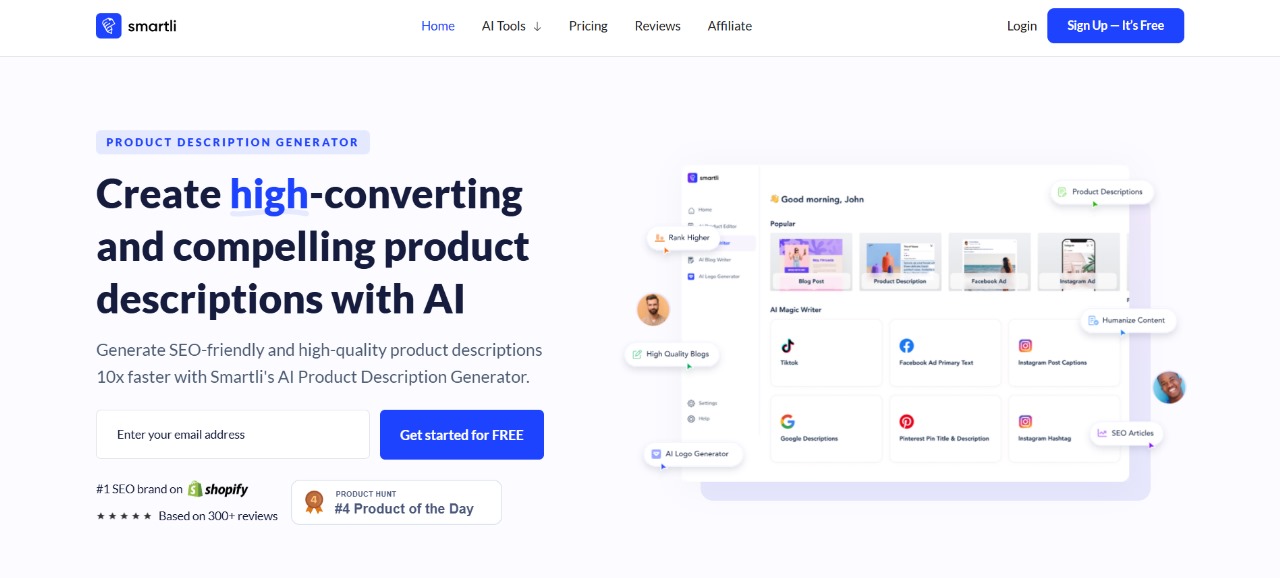
What is Smartli — Solve Shopify product-description headaches and scale unique SEO copy
Estimated reading time: 15 minutes
Key Takeaways:
- Smartli automates the creation, optimization, and localization of Shopify product descriptions at scale.
- Enhances SEO metadata, ensuring better search visibility and higher click-through rates.
- Smartli’s bulk generator and template-driven workflows save time and maintain a consistent brand voice across large catalogs.
- Offers cost-effective and efficient solutions compared to competitors for ecommerce copy management.
Table of Contents:
Quick Entry
What is Smartli for Shopify Product Descriptions
Common Problems Smartli Solves
Why Poor Product Copy is Costly
Smartli: The Practical Fix for Shopify Product Copy
Step-by-Step with Smartli: From Setup to Shipping Copy
Advanced Workflows
Real Gains and Expected ROI from Smartli
Conclusion
Frequently Asked Questions
Quick Entry
Smartli is an AI-driven tool built to generate, rewrite, and optimize product copy at scale for Shopify stores. Think of it as a focused Smartli AI assistant: it creates Smartli product descriptions, produces SEO-friendly metadata, and offers bulk workflows to change tone or translate catalogs quickly.
If you manage an ecommerce catalog, Smartli functions like a production line for words — templates, bulk generator modes, and rewrite options let you treat 10 or 10,000 SKUs the same way. Below I explain the main problem Smartli solves, the common catalog issues it targets, and why fixing them matters for conversion and SEO.
What is Smartli for Shopify Product Descriptions
Large Shopify catalogs break down under three realities: rules don’t scale, human writers burn out, and search engines reward unique, structured product copy. When merchants try to write descriptions by hand they face inconsistent tone across a catalog, weak Smartli SEO metadata, and grueling bulk editing sessions that eat time and introduce errors. Imagine trying to tune an orchestra one instrument at a time while the concert is starting — that’s what editing thousands of product pages manually feels like.
Smartli AI is designed to replace that one-by-one approach. Using Smartli templates and a Smartli bulk generator, teams can define a tone of voice, map attributes (size, material, use cases), and output repeatable, SEO-optimized descriptions in batches. The tool also offers Smartli rewrite modes for refreshing legacy listings and localization workflows to speed slow translation efforts. For store managers asking how to write Shopify product descriptions with Smartli, the process becomes: set a template, push attributes, review samples, and publish — not rewrite every page from scratch.
Common Problems Smartli Solves for Shopify Catalogs
Inconsistent Tone
Most stores grow by adding suppliers and freelancers; the result is a catalog that sounds like multiple brands mashed together. That confuses customers and dilutes brand trust. Smartli lets you lock a voice at the template level, then apply it across thousands of SKUs so your catalog reads like one coherent brand.
Weak SEO Metadata
Product descriptions and meta tags are often afterthoughts. Poorly structured or duplicated copy kills long-tail visibility. Smartli SEO features generate keyword-friendly titles, meta descriptions, and structured bullets tailored to each product’s attributes, which helps search engines and improves click-through rates.
Slow Localization and Bulk Edits
Translating collections or switching terminology across a catalog is tedious. Smartli’s bulk generator and rewrite capabilities automate mass changes—swap “trainer” to “sneaker” across pages or localize measurements for different markets in minutes, not weeks. For teams comparing Smartli vs Copysmith or Smartli vs Writesonic for ecommerce, the edge often comes down to these bulk and template-driven workflows rather than single-item copy quality.
Why Poor Product Copy is Costly for Ecommerce
Bad product copy is a leaky sales funnel. Low-converting descriptions mean higher ad costs to hit revenue targets, wasted traffic, and missed organic growth. Even a small lift in clarity or uniqueness across top SKUs can compound into meaningful revenue gains.
Beyond conversions, duplicated or thin descriptions limit search visibility and make paid campaigns inefficient. Fixing this at scale without burning staff hours is the core ROI Smartli promises — which is why prioritizing templates and bulk workflows is practical first-step advice before rewriting every product page by hand.
Smartli: The Practical Fix for Shopify Product Copy
If your catalog problems sound familiar—missing metadata, inconsistent tone, slow translations—Smartli is the practical fix built for those exact pain points. In plain terms, Smartli is an AI-powered Shopify app that turns raw product attributes into search-friendly, buyer-focused copy. It’s not a generic writing tool; it’s designed around ecommerce workflows: templates for tone and structure, a bulk generator for mass outputs, and rewrite modes to refresh legacy listings without manual rework.
Where teams typically lose hours—mapping specs into readable bullets, crafting unique meta descriptions, or applying a single brand voice to thousands of SKUs—Smartli automates the repetitive parts and exposes lightweight review checkpoints. It also integrates SEO controls so titles, headers, and meta descriptions include relevant phrases for better organic visibility. For merchants evaluating Smartli vs Copysmith or Smartli vs Writesonic for ecommerce, that workflow orientation (templates + bulk generator + Shopify app integration) is the differentiator.
Smartli also streamlines localization: convert measurements, swap regional terms, or translate copy across markets in batch. That means fewer post-publish fixes and a faster path to testing international ads. If your search intent is “what is Smartli” to determine fit for Shopify SEO and scaling product descriptions, the short answer is: an AI assistant optimized specifically to produce and manage Smartli product descriptions at catalog scale.
Step-by-Step with Smartli: From Setup to Shipping Copy
Install and Connect
- Install the Smartli Shopify app (or add via the Smartli app listing). Grant read/write access to products and collections so the app can pull attributes and push descriptions.
- If you prefer CSV workflows, export your product feed from Shopify and upload it to Smartli’s dashboard.
Map Attributes and Choose a Template
- Smartli asks you to map product attributes (title, type, material, size, key features). Clean attribute mapping avoids generic outputs.
- Choose a Smartli template that fits your brand: short sales copy, long-form storytelling, feature/benefit bullets, or metadata-only. Templates lock structure and tone—so your catalog reads consistently.
Set Tone, SEO Focus, and Keywords
- Define a global tone (professional, playful, minimal) and any SKU-level overrides.
- Add target keywords for priority SKUs or collections. Smartli SEO settings let you prioritize primary and secondary keywords per template so generated titles and meta descriptions are optimized without keyword stuffing.
- For guidance on meta best practices, pair outputs with Google’s SEO starter guide to ensure characters and structure match search expectations.
Run the Smartli AI Bulk Description Generator
- Select items or an entire collection and run the bulk generator. The app will produce multiple variations per SKU if you want A/B test samples.
- Use the Smartli rewrite mode to refresh existing copy—set rules to preserve brand claims while swapping language or structure.
Review and Iterate
- Smartli surfaces sample outputs for quick approval. Approve, request regenerations, or edit inline.
- Test variations on a subset of SKUs to measure CTR and conversion before a full roll-out.
Publish and Measure
- Publish directly back to Shopify or export updated CSVs.
- Track impact in analytics: organic impressions, CTR, conversion rate, and ad CPA. Smartli stores change logs so you can revert or iterate.
Advanced Workflows
- Use bulk localization to translate or convert measurements across markets in minutes.
- Leverage template versioning to A/B test tone or product page structure.
- For teams juggling many AI tools, see our Smartli AI Tool review and hands-on testing for a closer look at performance and real-world examples. Also consult our comprehensive directory of AI tools for ecommerce to compare alternatives and integrations.
Real Gains and Expected ROI from Smartli
Smartli compresses months of manual editing into hours. The most immediate ROI is time: store teams report multi-day tasks (catalog rewrites, localization passes) cut down to single sessions using Smartli templates and the bulk generator. That reduces reliance on ad-driven traffic to hit revenue, because clearer, unique Smartli product descriptions improve organic click-through and buyer confidence.
On the SEO side, Smartli SEO outputs eliminate thin, duplicated descriptions and produce metadata that ranks and converts better. For merchants asking “is Smartli good for Shopify SEO?” the answer is yes—when templates are configured with targeted keywords and follow on-page best practices, organic performance typically improves faster than manual rewrites can be completed.
Cost comparisons matter: Smartli pricing is often lower than hiring a team of freelancers for ongoing catalog work, especially when you factor in localization and iterative optimization. Expect gains in consistency (single brand voice), speed (bulk edits and rewrites), and reduced operational drag (less back-and-forth with copywriters).
Beyond direct savings, there’s strategic upside—faster launches for new SKUs, better-performing landing pages for campaigns, and the ability to scale descriptions as your catalog grows. If you’re still wondering what is Smartli and whether it fits your stack, consider a short pilot on a high-value collection to measure lift before a full rollout.
Conclusion
Smartli is built to remove the busywork from ecommerce copy so merchants can focus on conversion and growth. It combines purpose-built templates, a Smartli AI bulk description generator, and Shopify-native publishing to produce consistent, SEO-minded product copy at scale. That matters because inconsistent tone, duplicated metadata, and slow localization all drain conversion and slow expansion into new markets. With Smartli rewrite and template versioning you can refresh legacy listings quickly and test voice or structure across collections.
Beyond speed, Smartli improves discoverability. When you configure Smartli SEO settings and map attributes cleanly, titles, headings, and meta descriptions align with search intent and best practices. Use the Google SEO starter guide to validate structure and character limits while you tune templates. For teams evaluating alternatives—Smartli vs Copysmith or Smartli vs Writesonic for ecommerce—the app-focused workflow, bulk generator, and Shopify integration consistently reduce time-to-publish and lower ongoing costs compared with manual edits or general-purpose AI.
Smartli also pays back through better operational rhythm: fewer manual edits, faster localization passes, and an auditable change log so rollback is simple. If you want to experiment, run a short pilot on a high-value collection and measure impressions, CTR, and conversions before expanding. For a deeper hands-on look, read our in-depth Smartli review and browse other recommended tools in our AI tools directory. If you’re still wondering What is Smartli for your store, a quick trial will show how it solves catalog-scale copy problems practically and measurably.
Smarti FAQs
Is Smartli good for Shopify SEO?
Is Smartli good for Shopify SEO?
Yes—Smartli is well-suited for enhancing Shopify SEO through its AI-powered content tools. It specializes in generating SEO-optimized product descriptions, blogs, and ads that incorporate target keywords and clear structure designed to boost organic visibility. Smartli’s AI focuses on crafting copy that resonates with search intent and supports conversion goals—making it particularly valuable for e‑commerce users.
User reviews and case studies reinforce these benefits. Shopify merchants report noticeable traffic gains, often around up to a 30% increase, thanks to Smartli’s ability to automate keyword inclusion, refine readability, and deliver SEO-friendly content consistently.
How Smartli Supports Shopify SEO in Practice
| Feature | SEO Benefit |
|---|---|
| SEO-Boosted Descriptions & Blogs | Integrates relevant keywords and structured content to improve SERP rankings. |
| Bulk Generation | Enables large-scale, consistent optimization across numerous product listings. |
| Custom Tone & Keyword Input | Helps tailor content for specific search terms and buyer intent, making it more discoverable and engaging. |
Can Smartli rewrite existing product copy without losing keywords?
Can Smartli rewrite existing product copy without losing keywords?
Yes — Smartli’s AI Rewriter capability is designed to paraphrase and refine your existing product descriptions while preserving important keywords and SEO value. Unlike a full rewrite that may strip out brand terms or focal points, the rewriter reshapes your text—enhancing clarity, tone, and uniqueness—without compromising your target keywords or core messaging. This makes Smartli especially useful for e-commerce businesses looking to refresh content, maintain SEO consistency, and add freshness without losing visibility or optimization.
How does Smartli integrate with Shopify and what permissions are required?
How does Smartli integrate with Shopify and what permissions are required?
Smartli integrates seamlessly with Shopify: after signing up, simply connect your Shopify store via the app’s onboarding flow. This integration allows Smartli to import your product catalog, enabling the AI to generate SEO-optimized product descriptions, blog posts, ad copy, and more—all ready to publish directly to your store.
To make this possible, Smartli requires read access to your product data so it can pull item details and metadata for content generation. It typically asks for permissions like reading product listings, modifying content pages, and publishing updates. These access rights align with standard Shopify app permissions and are necessary for Smartli to function effectively as your integrated AI copywriting assistant.
How does Smartli pricing compare to other AI writing tools?</
How does Smartli pricing compare to other AI writing tools?</
Smartli offers tiered pricing that’s highly competitive, especially for e-commerce and SEO-focused users. Its monthly plans include:
Starter – $29/month: 20 AI-optimized product descriptions with keyword suggestions.
Pro – $59/month: 100 product descriptions, 10 AI-generated blogs, ads, and VIP support.
Empire – $99/month: 1,000 descriptions, 50 blogs, and premium support.
Unicorn – $299/month: unlimited content and full VIP service.
All plans come with a 7-day free trial.
Compared to other tools, Jasper starts at around $29/month but focuses more on general creative writing, while Writesonic plans begin around $25–35/month with broader marketing features. Smartli is often a better value for Shopify users because it’s specialized in SEO-driven product copy and store content, making it more cost-effective if your main goal is boosting organic visibility and conversions.
CharlieAITools was created with love to help you discover the best AI tools and transform your life, your ideas, and your projects. By signing up through my affiliate link, you help me keep this site running and continue to share valuable resources with fellow entrepreneurs. Thanks a ton for your support!