

Hyper3D Rodin
Hyper3D Rodin Review: Is This AI 3D model generator the Future of Asset Creation? In this Hyper3D Rodin review, we’ll dive into how this innovative platform is transforming 3D asset generation, who stands to benefit…

Hyper3D Rodin
The world of 3D content creation has long been a domain requiring specialized skills, significant time, and often, a hefty budget. But what if you could bypass much of that complexity, generating high-quality 3D models from simple text prompts or images? That’s the promise of Hyper3D Rodin, an AI-powered solution designed to democratize and accelerate 3D asset creation. If you’re an artist, developer, or designer looking to streamline your workflow and unlock new creative possibilities, this review will help you understand if Hyper3D Rodin is the game-changer you’ve been searching for.
Hyper3D Rodin is an advanced AI 3D model generator that empowers users to create detailed, production-ready 3D assets from various inputs, primarily text descriptions and 2D images. It functions as a web-based platform, leveraging sophisticated artificial intelligence to interpret user prompts and synthesize complex three-dimensional models, aiming to significantly reduce the manual effort and specialized expertise traditionally required for 3D content creation.
In today’s fast-paced digital landscape, the demand for high-quality 3D content is exploding across industries like gaming, AR/VR, e-commerce, and animation. However, the traditional process of 3D modeling is notoriously time-consuming, expensive, and demands a steep learning curve. Many professionals, from indie game developers to product designers, find themselves constrained by limited budgets, tight deadlines, or a lack of specialized 3D modeling skills.
This often leads to inefficient workflows and compromises on creative vision.This is where an AI 3D generator like Hyper3D Rodin steps in as a crucial solution. It directly addresses the core pain points faced by creators: the high cost of hiring skilled 3D artists, the lengthy production times for assets, and the technical barrier to entry for complex 3D software. By automating much of the initial modeling process, this platform allows users to rapidly prototype, iterate, and generate assets that would otherwise take hours or days of manual work.
It transforms abstract ideas or existing 2D visuals into tangible 3D models, making sophisticated 3D creation accessible to a much broader audience.The importance of such a tool extends beyond mere efficiency; it’s about empowerment. It enables individuals and small teams to compete with larger studios by providing a cost-effective way to populate their projects with unique, high-quality 3D assets. Imagine an indie game developer, like our persona Alex, who can generate a diverse range of environmental props or character elements with just a few prompts, freeing up valuable time to focus on game mechanics and storytelling. Hyper3D Rodin isn’t just a convenience; it’s a strategic advantage for anyone looking to bring their 3D visions to life without the traditional bottlenecks.
Hyper3D Rodin is designed with a suite of features aimed at making 3D asset generation both powerful and accessible. Here’s a look at its core capabilities:
This core feature allows users to describe their desired 3D object using natural language prompts. The AI interprets these descriptions to synthesize a corresponding 3D model, enabling rapid prototyping and concept visualization without any manual modeling.
Beyond text, the platform can also convert 2D images into 3D models. Users can upload a photograph or illustration, and the AI will attempt to reconstruct it in three dimensions, providing a powerful way to digitize existing visual concepts.
The generated models are designed to be high-quality and suitable for professional use. This often includes clean topology, optimized mesh, and potentially PBR (Physically Based Rendering) textures, making them ready for integration into game engines, rendering software, or 3D printing workflows.
While AI handles the initial generation, the platform typically includes tools for users to refine, adjust, and customize the output. This ensures that creators maintain a degree of control over the final asset, allowing for tweaks to shape, texture, and detail to match specific project requirements.
For larger studios or those with specific integration needs, Hyper3D Rodin may offer an API (Application Programming Interface). This allows developers to programmatically generate 3D assets and integrate the platform’s capabilities directly into their existing software pipelines and custom tools.
To facilitate seamless integration into professional workflows, the platform may provide plugins or connectors for widely used 3D software such as Blender, Unity, and Unreal Engine. This enables users to directly import and work with AI-generated models within their preferred creative environments.
Hyper3D Rodin is a powerful AI 3D model generator designed to serve a diverse range of professionals and enthusiasts who need efficient and cost-effective 3D asset creation.
❤️ Also loved by: Motion Graphics Designers, Character Designers, Virtual Environment Designers, Technical Artists, Hobbyists, Students, Marketing Professionals, E-commerce Content Creators, Digital Sculptors, VFX Artists, Metaverse Builders, Content Creators, Educators, Researchers.
Hyper3D Rodin fits into these categories. Explore each page for alternatives and related tools.
If Hyper3D Rodin is not a perfect fit, these alternative AI tools may cover different budgets, features, and use cases in AI 3D MODELING. Compare strengths, positioning, and why each tool might be a better fit for a specific workflow.
Specific pricing details for Hyper3D Rodin are not clearly specified in the provided context. However, AI 3D model generators typically offer various pricing models, which may include subscription tiers based on usage (e.g., number of generations, model complexity, export formats), access to different AI models, or premium features like API access and advanced refinement tools.
The value of such a platform often lies in its ability to significantly reduce production time and costs compared to traditional 3D modeling, making it a worthwhile investment for professionals and businesses. Users should always check the official Hyper3D Rodin website for the most current and detailed information regarding pricing, available plans, features included in each tier, and any trial options before making a decision. Pricing, plans, and model access may evolve as the company releases updates.
If the challenges of manual 3D modeling are holding back your creative projects, or if you’re eager to explore the incredible potential of AI in asset creation, Hyper3D Rodin offers a compelling solution. Imagine rapidly bringing your ideas to life, whether you’re building a new game world, designing a product, or crafting an immersive AR/VR experience. This platform is poised to empower you with speed, efficiency, and a newfound creative freedom. Don’t let traditional bottlenecks limit your vision any longer.
Ready to see how this AI 3D model generator can fit into your pipeline?
Visit Hyper3D Rodin today to explore its capabilities and discover how it can accelerate your journey from concept to creation.
CharlieAITools was created with love to help you discover the best AI tools and transform your life, your ideas, and your projects. By signing up through my affiliate link, you help me keep this site running and continue to share valuable resources with fellow entrepreneurs. Thanks a ton for your support! 💛

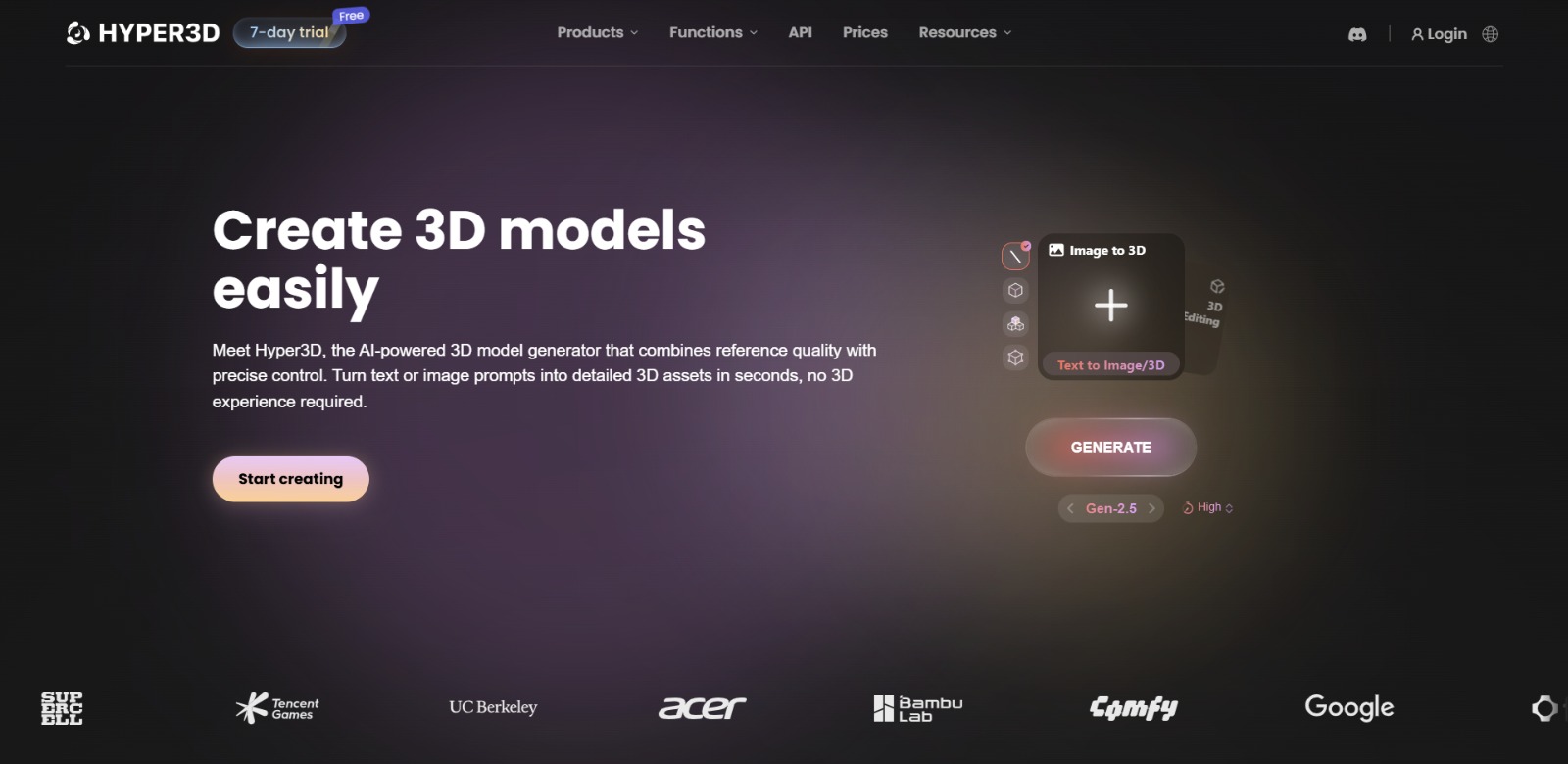
Hyper3D Rodin Review: Is This AI 3D model generator the Future of Asset Creation? In this Hyper3D Rodin review, we’ll dive into how this innovative platform is transforming 3D asset generation, who stands to benefit…

Tripo AI Review: Is This AI 3D model generator Worth It? In this Tripo AI review, we’ll look at its key features, best use cases, pricing, pros and cons, and whether it is a good fit for your workflow. In the fast-paced…

Meshy Review: Unlocking Rapid AI 3D Model Generation for Creators In this Meshy review, we’ll explore its core capabilities, who stands to benefit most, its advantages and limitations, and how it can streamline your 3D…

Copy.ai Review: Is This GTM AI platform Worth It for Your Business? In this Copy.ai review, we’ll explore how this AI platform can streamline your GTM strategy, boost productivity, and help you decide if it’s the right…


Jasper Review: Is This AI marketing tools Worth It? In this Jasper review, you’ll learn how it works, who it is best for, and how it compares with other AI marketing tools. In today’s fast-paced digital landscape,…

Tableau Next Review: Elevating Data Insights with Next-Gen AI Business Intelligence In this Tableau Next review, we’ll explore how this advanced platform aims to transform data analysis, its core features, who stands to…

To provide the best experiences, we and our partners use technologies like cookies to store and/or access device information. Consenting to these technologies will allow us and our partners to process personal data such as browsing behavior or unique IDs on this site and show (non-) personalized ads. Not consenting or withdrawing consent, may adversely affect certain features and functions.
Click below to consent to the above or make granular choices. Your choices will be applied to this site only. You can change your settings at any time, including withdrawing your consent, by using the toggles on the Cookie Policy, or by clicking on the manage consent button at the bottom of the screen.