
What Is WorldEngen and How Does It Help with AI for Game Development?
In the dynamic world of game development, animation, and virtual production, creating detailed and immersive 3D environments is often a monumental task. Artists and studios constantly seek innovative ways to accelerate their workflows without compromising quality or creativity. This drive for efficiency is precisely why many professionals are asking: what is WorldEngen?
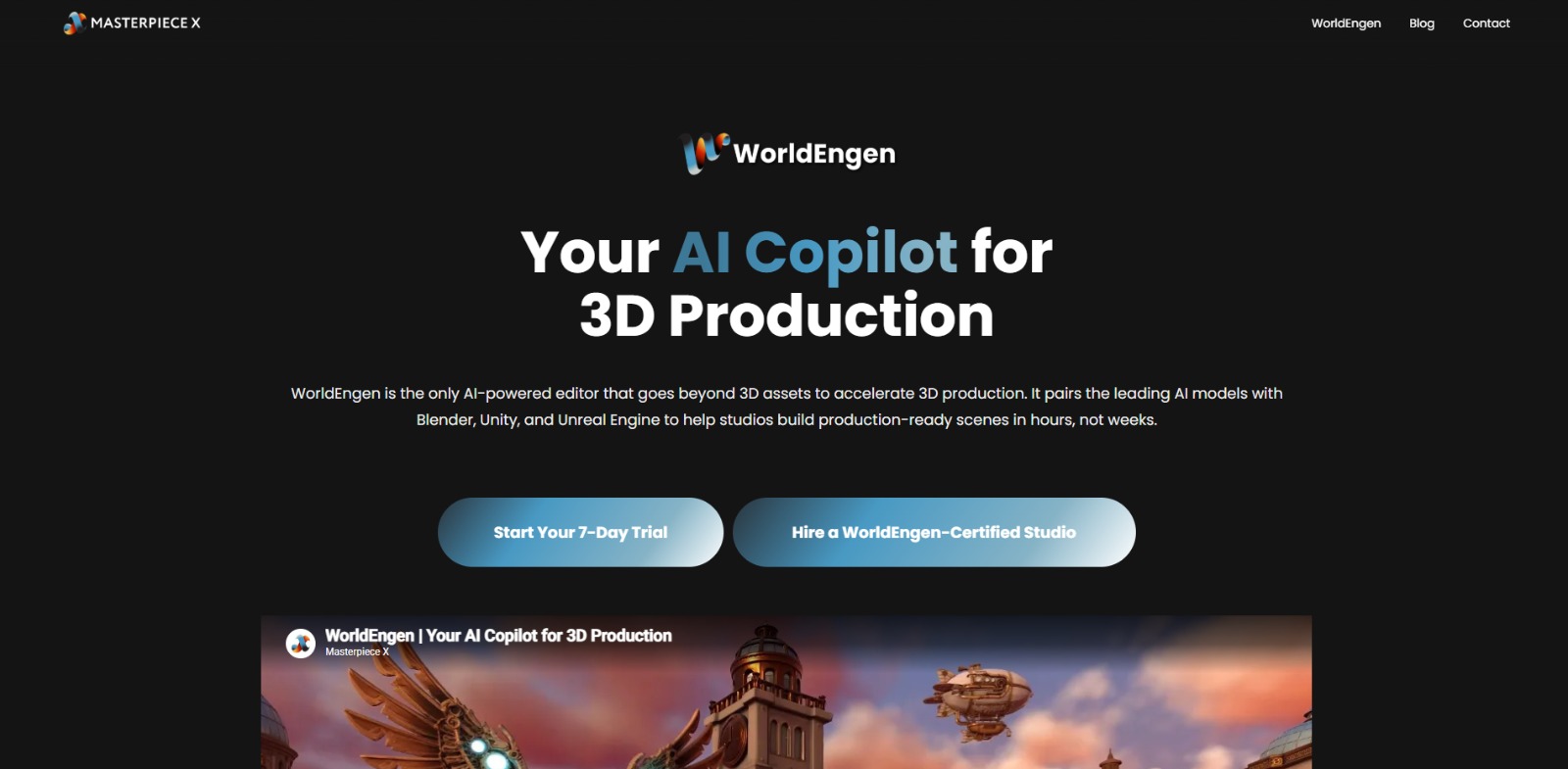
WorldEngen emerges as a powerful AI-powered co-pilot designed to revolutionize 3D scene creation. Understanding this platform is crucial for anyone looking to streamline their production pipeline, reduce costs, and unlock new levels of creative freedom through AI for game development and beyond. It promises to transform how you build worlds, making complex tasks more manageable and rapid iteration a reality. After learning What Is WorldEngen, visit our full WorldEngen Review to see if it’s the right AI tool for your workflow.
The Core Challenge: The Time and Cost of Traditional 3D Scene Creation
Creating expansive and immersive 3D environments for games, films, or simulations is a cornerstone of modern digital production, yet it remains one of the most time-consuming and costly aspects. The traditional workflow involves a painstaking manual process: artists must meticulously model, texture, and then individually place countless assets—from intricate architectural details to sprawling natural landscapes. Each element requires precise positioning, scaling, and lighting adjustments to achieve a cohesive and believable scene.
This extensive manual labor, often termed “set dressing” or “worldbuilding,” consumes vast amounts of human resources and development time. For studios and independent creators alike, this translates directly into higher production budgets and significantly longer project timelines. The complexity of managing thousands of assets, ensuring consistent visual quality, and optimizing performance across diverse scenes can quickly become overwhelming, forcing difficult compromises between artistic vision and practical constraints. This challenge frequently leads to delays and budget overruns, impacting a project’s overall viability and competitive edge.
Beyond Manual Labor: Iteration Delays and Creative Bottlenecks
Beyond the sheer manual effort, 3D artists and game developers frequently encounter significant hurdles with iteration. Once a scene is built, making substantial changes—whether adjusting a layout, experimenting with a new visual style, or responding to feedback—can be incredibly time-consuming and disruptive. Each modification often requires re-adjusting multiple elements, creating a slow, costly feedback loop that stifles experimentation and delays refinement in the creative process.
This difficulty in rapid iteration directly impacts a project’s quality and innovation. Artists, like our persona Alex the Game Developer, often feel frustrated by the gap between initial concept art and the final production-ready environment. Translating a dynamic creative vision into static 3D assets and arranging them effectively can be a tedious process, diverting focus from artistic direction to technical execution and leading to creative bottlenecks.
Moreover, many 3D production pipelines are plagued by repetitive tasks. Placing similar objects, generating variations of environmental elements, or performing routine adjustments can become monotonous and lead to artist burnout. These necessary but uninspiring tasks detract from the more engaging aspects of worldbuilding, making it harder for teams to scale their art production for larger, more ambitious projects within tight deadlines.
Why These Challenges Impact Your Projects and Creativity
The cumulative effect of these challenges is far-reaching, directly impacting a project’s viability and creative potential. Extended development cycles due to manual labor and slow iteration mean higher operational costs, often pushing projects over budget. For studios, this can translate into missed market opportunities, as competitors who adopt more efficient workflows can release content faster and capture audience attention.
Beyond financial implications, these problems take a significant toll on creative teams. Artists become bogged down in the minutiae of asset placement and technical adjustments, rather than focusing on the artistic direction, storytelling, and overall immersive experience. This can lead to creative blocks, reduced job satisfaction, and a feeling that their artistic vision is being compromised by the limitations of the production pipeline.
Ultimately, the inability to rapidly prototype, iterate, and scale 3D content creation can limit the ambition and scope of projects. It forces creators to compromise on detail, scale, or visual fidelity, preventing them from delivering the truly groundbreaking experiences they envision. In a competitive industry, such limitations can be the difference between a project that captivates its audience and one that struggles to stand out.
WorldEngen: Your AI Co-Pilot for Rapid 3D World Creation
So, we’ve explored the gnarly bits of traditional 3D scene creation—the endless manual tasks, the creative roadblocks, and the budget-busting iteration delays. It’s enough to make even the most passionate game developer sigh, right? This is precisely where WorldEngen steps in, not as a replacement for human creativity, but as a powerful AI co-pilot designed to tackle these very challenges head-on.
WorldEngen is the practical fix you’ve been looking for, transforming those painstaking processes into streamlined, efficient workflows. It’s an AI solution that understands the core pain points of artists and studios, offering a smarter way to build expansive and immersive 3D environments. If you’re asking, “what is this AI tool and how can it genuinely help me?”, WorldEngen is about unlocking speed, reducing costs, and amplifying your artistic vision.
How WorldEngen Works: From Concept to Immersive 3D Scene
Understanding how WorldEngen operates is key to appreciating its power. Think of it as a highly intuitive assistant that takes your creative ideas and translates them into tangible 3D scenes with remarkable speed. The general workflow is designed to be accessible for beginners while offering depth for seasoned professionals, making the complex task of worldbuilding much more manageable.
1. Input Your Vision
It all starts with your input. You might begin by providing WorldEngen with a simple text prompt describing the scene you envision—perhaps “a lush, overgrown ancient temple ruin at sunset.” Alternatively, you could upload reference images, sketches, or even basic 2D layouts to give the AI a visual starting point. This initial step is about communicating your creative intent in the most natural way possible.
2. AI-Powered Scene Generation
Once WorldEngen receives your input, its AI engine gets to work. It leverages vast datasets of 3D assets and environmental knowledge to generate an initial version of your scene. This isn’t just random placement; the AI intelligently considers elements like composition, lighting, and asset compatibility to create a cohesive and visually plausible environment. It’s like having a team of digital artists working at lightning speed.
3. Iterate and Refine with Ease
Here’s where the “co-pilot” truly shines. The initial AI-generated scene serves as a robust foundation, but it’s rarely the final product. You can then interact with the scene, providing feedback and making adjustments. Want to change the time of day? Add more foliage? Move a structure? WorldEngen allows for rapid iteration, applying your modifications quickly and intelligently, often with just a few clicks or new prompts.
4. Asset Integration and Customization
WorldEngen isn’t a closed system. It’s designed to work with your existing asset libraries. You can import your own custom 3D models, textures, and materials, and the AI will integrate them seamlessly into the generated scene. This ensures that your unique artistic style and branding are maintained, while still benefiting from the AI’s speed in populating and arranging the environment. It’s about enhancing, not replacing, your assets.
5. Export and Integrate into Your Pipeline
Once you’re happy with your masterpiece, WorldEngen allows you to export the finished 3D scene in standard file formats compatible with popular game engines and 3D software. This means the worlds you create with WorldEngen can be seamlessly integrated into your existing production pipeline, ready for further detailing, animation, or immediate use in your game, film, or virtual experience. It truly bridges the gap between concept and production.
The WorldEngen Advantage: Unleashing Creativity and Efficiency
The real magic of WorldEngen lies in its ability to transform the entire 3D scene creation process, offering benefits that resonate deeply with the challenges we discussed earlier. Imagine reclaiming countless hours previously spent on repetitive tasks, redirecting that energy into pure creative exploration. This AI solution is all about giving you back control over your time and artistic vision.
By automating the most laborious aspects of worldbuilding, WorldEngen drastically cuts down on development cycles and associated costs. Artists are no longer bogged down in the minutiae of asset placement; instead, they can focus on storytelling, atmosphere, and iterating on grander ideas. This leads to faster prototyping, more ambitious projects, and ultimately, higher quality, more immersive experiences for your audience, without compromising on detail or scale.
WorldEngen: Empowering Your Creative Flow in 3D
So, we’ve journeyed through the intricate world of 3D scene creation and seen how WorldEngen steps up as a truly transformative AI co-pilot. It’s clear that this isn’t just another tool; it’s a strategic partner for anyone looking to overcome the traditional hurdles of worldbuilding. By automating tedious tasks and accelerating iteration, WorldEngen frees up valuable time and resources, allowing artists and developers to focus on what they do best: creating captivating experiences.
For game developers, filmmakers, architects, or virtual reality creators, understanding what this AI tool offers means unlocking new levels of efficiency and creative freedom. WorldEngen’s durable value lies in its ability to consistently deliver speed, cost savings, and a streamlined workflow, making ambitious projects more achievable. It’s about turning complex visions into immersive realities, faster and with less friction.
Transform Your 3D Workflow and Unleash Your Vision
Imagine a world where your creative ideas aren’t bottlenecked by endless manual tasks or budget constraints. WorldEngen is built to make that a reality, empowering you to bring your most ambitious 3D visions to life with unprecedented speed and efficiency. It’s about reclaiming your time, amplifying your artistic output, and delivering truly immersive experiences that captivate your audience. Ready to see how much more you can achieve?
Discover WorldEngen and start building your next masterpiece!
WorldEngen FAQs
What is WorldEngen used for?
What is WorldEngen used for?
Who is WorldEngen best for?
Who is WorldEngen best for?
How does WorldEngen generally work?
How does WorldEngen generally work?
Is WorldEngen beginner-friendly?
Is WorldEngen beginner-friendly?
CharlieAITools was created with love to help you discover the best AI tools and transform your life, your ideas, and your projects. We aim to share valuable resources with fellow entrepreneurs. Thanks a ton for your support!